
After a fire, the soot gets cleaned off and the building looks almost normal. The question every engineer, owner and insurer then asks is the same: is the concrete still good?
You can't answer that by looking. The only reliable way is to take samples of the actual concrete and test them. This month ConcreteX did exactly that on two fire-damaged Sydney buildings: a carpark roof slab and a run of concrete wall panels. Here's how it works and what we found.
What fire does to concrete
Concrete doesn't burn, but it does change when it gets hot enough:
- Strength drops. Concrete exposed to high temperatures can lose a meaningful share of its compressive strength, and the hotter and longer the fire, the deeper the damage goes.
- It changes colour. Heated concrete often turns pink or reddish, depending on the aggregate. That pink band is one of the most useful clues for finding how deep the heat got in.
- It cracks and spalls. Surface layers can crack, flake or break away, sometimes exposing the reinforcement.
- The reo can be affected. Steel loses strength when heated, and exposed or near-surface bars are most at risk.
The key point is that fire damage is usually a gradient. The surface closest to the fire is hit hardest, and the concrete gets better the deeper (or further away) you go. Good testing is designed to measure that gradient, not just grab a random sample.
Reading the damage, core by core
Fire-affected wall panels from the industrial job below. Tap a core to see what it showed.
Core #3
Damage groupUpper panel, in the worst-hit area. The deepest heat penetration on the job.
Pink zone: 20 mm
How we test it
- Scan before we drill
Every core location is scanned with ground penetrating radar (GPR) so we drill clear of reinforcement, post-tensioning and live services. Where the engineer needs it, we also map bar spacing, layers and cover. More on concrete scanning.
- Core in groups, not at random
We take reference cores from sound concrete away from the fire, then cores from the damaged areas, and sometimes cores in between to find where the damage stops. That gives the engineer a baseline to compare against. More on core drilling.
- Log every core
Each core is photographed and measured on site, and we record the depth of any pink heat-affected zone from the exposed face.
- Lab test
Cores are bagged, labelled and delivered to a NATA-accredited laboratory for compressive strength testing to AS 1012.14 (and density where required). More on core sampling and testing.
- One report
Locations, scan findings, core photos, observations and the lab certificate, all in one document the engineer can use straight away.
We don't do the structural assessment ourselves. Our job is to give the engineer accurate, well-located data so they can make the call.
Carpark roof slab after an underground fire
A fire in the underground carpark of a residential building left the roof slab above in question. The carpark was off limits, so we did everything from the topside, drilling through the tiled paving.
- GPR scanning at 8 locations nominated by the client, with reinforcement mapping at 5 of them
- Two layers of reinforcement found at 200 mm centres each way; one location turned out to sit over a 450 mm deep beam
- 8 cores for strength testing, plus 1 extra core drilled over a bar to confirm bar size (12 mm)
The results gave the engineer a strength figure for every location across the slab, and picked out the one area that needed a closer look.
Fire-affected concrete wall panels
On an industrial site in Western Sydney, the engineer needed to know whether a run of fire-affected concrete wall panels could be kept and repaired, or had to come out. We set out 7 cores in three groups:
| Group | Where | Why | Pink zone |
|---|---|---|---|
| Reference (2 cores) | Lower panel, sound concrete | Baseline strength | None |
| Mid height (2 cores) | Highest point the render was still intact | Find where damage stops | None |
| Damage (3 cores) | Most fire-affected upper areas | Worst case | 10 to 20 mm |
The pattern was clear. Heat damage was limited to the top of the panels and only went 10 to 20 mm into the concrete. Below that, the cores were clean.
The strength results backed that up: the fire-affected upper cores tested in line with the reference cores from sound concrete.
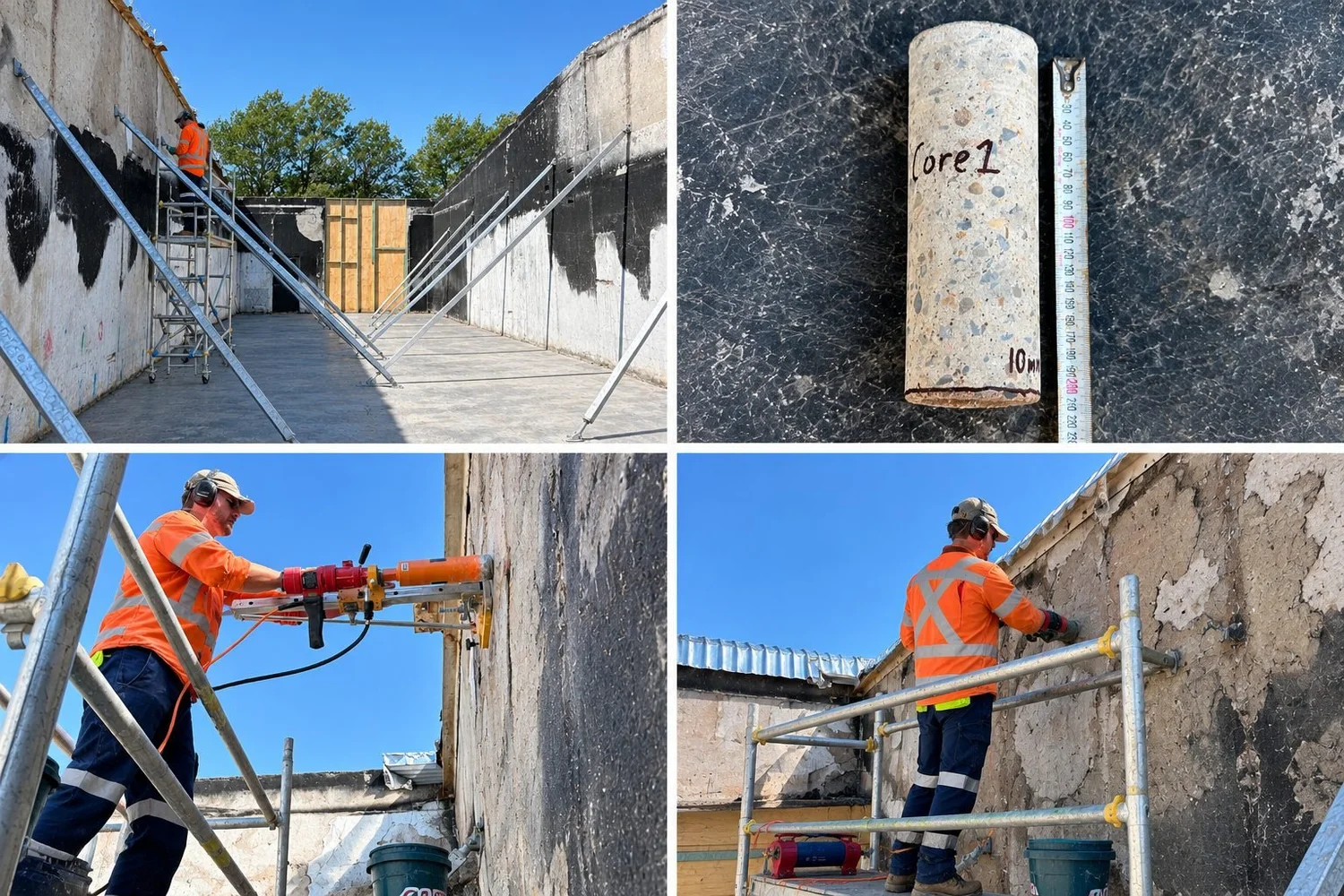
Because each strength result is for the whole trimmed core, we always note that it doesn't separately measure the thin heat-affected layer. That detail matters to the engineer, so it's in the report.
What the engineer gets
On both jobs the engineer got a single report with every core located, photographed and logged, the scan findings, and the lab certificate attached. That's enough to make a decision on repair, strengthening or replacement without a second site visit.
FAQ
How long does fire damage testing take?
Most jobs are one day on site. Lab testing and reporting usually take 1 to 2 weeks, depending on the lab's turnaround and how the cores need to be conditioned.
How many cores do I need?
Your engineer usually sets this in their investigation scope. As a guide, plan for cores in both the damaged and undamaged areas so there's a baseline to compare against. Our recent fire jobs used 7 and 9 cores.
Will coring damage the structure further?
Cores are small (typically 81 mm diameter) and every location is scanned first so we avoid cutting reinforcement or post-tensioning. Holes can be grouted afterwards.
Is the testing NATA accredited?
All compressive strength testing is carried out by NATA-accredited laboratories. ConcreteX does the scanning, coring, logging and reporting.
Dealing with fire damage?
ConcreteX scans, cores, tests and reports in one booking, anywhere in Sydney and NSW. Send us your engineer's scope or a few photos and we'll come back with a quote.
